Uncategorized

Footprints in the Sandbox

Everyone who has been involved in policing has been involved in investigations that cling to you. Especially those involving children. Those little beings with their whole lives ahead of them. Those files refuse to fade away. This is one such case for me and many others who worked on it. Two three year old girls drowned in Gander Lake while on an outing with their father in August 4th, 2002. In the playground, a single set of small footprints running across the sand toward the lake are depicted in one of the crime scene photographs.

An intensive investigation was conducted and years later, the father was charged with murder and convicted. However, on appeal he was acquitted in 2014. As far as I know the case remains open. I wrote the following poem about this tragedy.

The Drownings

The water wanted in and as much as

The small girls struggled to keep it out

It overpowered their trivial efforts and

Replaced their breath with

Its cold, liquid fingers showing their

Young and open little minds

Humans do not exist without air

They would float until it, the lake

Would claim them, sucking them below

The surface and away from those

They held dear

Their killer, walks free

Yet, he has no freedom

He is stuck in the quicksand of

Guilt, living his days

In a mental squalor

Their deaths in his thoughts

Knowing his deed

Maybe even regretting it

While two children

Blanketed with dirt sprouting grass

Sleep without breathing and

Slumber without dreams

Standard
Uncategorized

Pigs

No offence meant by the title of this week’s post. Back in my days of policing this was a common slur towards police. I am sure these are worse terms used today. This is meant to be a humorous look at this term through events that occurred during my service and personal life. I hope you enjoy it.

My wife and I lived in a Central Newfoundland in the late 1970’s and again in the early 1990’s.  When we posted there first, it was called Grand Falls and on our second time around it was Grand Falls-Windsor.  On the first occasion we lived in Bishop Falls until 1979 then we moved to the government quarters on Greenwood Avenue, Grand Falls.  There were four apartments there and we got the one in the middle.  We lived there until 1981 when I got transferred to Wesleyville.

While I was in Grand Falls, the detachment life was busy and almost every week you had to wrestle or fight with someone when you were making an arrest.  It seemed it was a badge of honor to the locals, which they could brag about.

“Yeah, the cops arrested me, but I didn’t go easy.” 

No one got hurt seriously other than a few scrapes and bruises.  Police officers back then did not have the pepper spray, batons, tasers or bullet proof vests.  You had a gun and handcuffs.  The gun was the last resort, to be used when you, or a member of the public, were in danger of being seriously injured or killed.  It was something that no officer wanted to use, even if justified.  It was rare the gun would be taken out of the holster; even rarer if it were fired.  Your tongue was your best weapon when dealing with someone.  Knowing how to reach a person who is in an agitated state due to mental health issues, or alcohol and drug use, was an invaluable skill.  It worked many times but there were always occasions when it did not and then you had to get physical.  

Your strength and fighting skills were important because, once you decide there was no other way, you had to be the winner.  Otherwise, the person went free and worse, the rumour mill would start.  That would encourage other persons to challenge you and other officers in the future.  You could not let that happen because it could result in injury or death.  Thankfully, most of the altercations were wrestling matches and with a few key moves remembered from training depot, the person was in custody.  It also helped things go more smoothly if there were other members around. 

Another popular thing in those days was being called a pig.  I remember during one of my first shifts I was driving on a street in Windsor, the town on the other side of the tracks from Grand Falls.  I saw a cute little fellow in blue jeans and a checkered shirt on the side of the road.  My guess was he was about four-years old.  I decided I would attempt some good community relations, so I stopped the car along side of him and rolled the window down.

“How are you doing, bud?”  I said smiling broadly.

“Fuck off, pig.”  He said giving me the middle finger.

I was somewhat shocked and paused for a moment as he ran into a nearby house.  What kind of a parent taught their child that type of language? I thought as I drove away.  It was quite common to be called a pig but coming from a four-year old child, it struck me to the core.  It bothered me that people would hate police so much they would teach their child, to imitate their behaviour. 

I would talk about this with my wife, Sharon and she told me I should not take it as an insult.  I asked why and she said because it is means Pride, Integrity, and Guts.  That meant a lot to me, and I remembered it throughout my policing career.  I even thanked a few of those souls when they called it out to me.  That quickly changed their sneer to a WTF expression which amused me, as opposed to being angry at being insulted. 

Sometime between that night and the second posting in 1991 to what was now Grand Falls-Windsor, Sharon started collecting pigs.  Not real ones, figurines.  She had them in all shapes and sizes and had them stashed in any available space around the house.  I did not mind as she enjoyed collecting them and come gift-giving times it made shopping for her easy.   The only one I regretted buying was a twelve-inch pig in a police uniform.  It was hollow inside for putting cookies in and it required two double A batteries.  It operated by a sensor and when you passed it the pig would say,

“Stop!  Take your hand out of the cookie jar!” 

It amused me for the first few weeks, but it got irritating fast.  Okay, maybe I was eating too many cookies.  It got on my nerves so much that one night a friend from work was visiting and remarked how cute it was.  I gave it to her right then.  She protested a little, but I said, no, a deal is a deal.  She was still saying she did not make any deal as I pushed her out the door and bid her goodnight.  I do not know what happened to the pig after that, I never saw it again.  Sharon asked me what happened to it, and I told her I dropped it and it broke so I threw it out.  She did not believe me; however, she did not say anything.  She was probably glad it was gone.  

I told you, because of these pigs, Sharon was easy to shop for, right?  Well, sometimes it was not quite as easy as you would think.  A couple of weeks before Christmas one year I was walking through the Exploits Valley Mall looking for some stocking stuffers for Sharon.  I was passing a Novelty Shop which had recently opened when a flash of pink caught my eye.  Pigs, I thought, as I quickly headed directly for them.  As I got close, I could see they were not pigs; these items were flesh coloured dildos.  I turned to leave but I was not quick enough for the ambitious store clerk.  Probably thinking about a big sale and telling his buddies about it the next day.

“Sale of a lifetime it was.  A case of dildos (or dildi).  Fellow was sweating a lot and looked kind of sketchy, but a sale is a sale, right.”   

“Can I help you with anything, sir.”  he said cordially after all I was the potential purchaser of a case of dildos.  He might even have a business card, ‘Dildo Sales and Service’. 

“No, no.  Just thought I saw something.”  How could I explain I thought these dildos were pigs?  For all I knew, he could have pig shaped dildos in the storeroom.  There are some weird tastes out there. 

“Thank you, for your help.”  I said backing out of the store as if from a rabid dog.  I exited the store and walked quickly to Woolco which was the anchor store of the mall.  I disappeared into the aisles and exited through the other door.  I walked to my car looking around as I went.  I do not know why, maybe I thought this guy, the dildo salesman, would follow me out to the parking lot shouting,

“But sir, the twelve-inch ones are fifty percent off.”  Waving a large flesh coloured one in his hand as he closed in on me. 

I quickly got in the car and drove away, vowing to see the eye doctor before I go shopping for pigs again. 

Standard
Uncategorized

The Church Parking Lot

I could never be described as a religious person.  Oh, I believe in God but my position in the cue at Heaven’s Gate is probably near the end of the line.  Years ago, I figured I was probably not good enough for Heaven; not bad enough for Hell; but I was probably a shoo-in for Purgatory.  It was the middle ground and given my character, the Purgatory Afterlife Resort seemed like a good fit for me.  These days, Purgatory does not get much attention.  Apparently, the word Purgatory it is not even mentioned in the Bible which does not disprove it, but it does not do much to bolster your confidence in its existence.  Perhaps with all the cutbacks in recent years, it may have been discontinued.  If someone can enlighten me on this issue it would be appreciated otherwise, a note to those of you at the back of the line.  The gloves are off!

I had lots of religious experiences in my youth, but I never realized its deep-seated influence until I began policing in Newfoundland (later to become Newfoundland and Labrador).  In many outport communities, the church, regardless of what denomination, plays a significant role in the everyday lives of the people who live there.  Sometimes as a police officer you get to see just how significant that influence is. 

One of the first things you learn as a police officer is that your job is a search for the truth.  A noble ideal indeed!  Right up there with, ‘The truth is out there’ on the X-Files TV show (I might be testing memories here).  You soon get brought down to earth when you find that not everyone wants to tell the truth, especially when there is a possibility they might get charged with a criminal offence.  Lying, you discover, is not a lost art.  In fact, it is very much alive and thriving, at least in the police world. 

It was 1974 and I was stationed in St. Lawrence, my first posting.  We received a call of a break and enter at a local business in Lawn.  I attended the scene with the senior member.  Soon after our arrival we came up with a suspect for the offence.  I do not remember who he was so I will reference him as Johnny.  We did not have much to go on, but we picked Johnny up anyway.   It was denial all the way as soon as he got in the police car.  Johnny had not done overly well with his education but in the school of lying he was an ‘A’ student. 

I was just out of training so to say that I was inexperienced at interviewing, would be kind.  I soon got into a heated, ‘You did it.’  ‘No, I didn’t.’ argument with Johnny but my partner was not concerned.  Perhaps it was that he had a good deal more service that me, I do not know.  He just drove on, content to let me do my broken record interrogation.  Suddenly, the car came to stop.  He put the gear shift in park.

I looked around to see we were parked on the empty parking lot of the Roman Catholic church.  ‘What is he doing?’ I thought as he spoke,

“Johnny, I’m going to ask you once and I want the truth.  Did you break into that store?

Johnny hesitated.  He looked around at his surroundings.  I noticed an obvious discomfort on his face.  His forehead and his upper lip were beading with sweat as he grasped his hands.  He stammered,

“I…I…”  Gone was the earlier confidence in his voice.

My partner shifted slightly in his seat and said firmly,

“Johnny?”

Johnny looked at the square jawed Mountie and then looked out the window.

“Alright, I did it.  I’m the one you want.”  He hung his head and stared at the floor. 

Utter amazement flooded over me.  This captain of liars was incapable of lying close to hallowed ground.  We could drive the police car back and forth over the boundary line of the church and the street and see the difference.  ‘Yes, I did it.  No, I didn’t.’ would be the responses depending, where you were when you asked the question.  I had visions of building an interview room on the church parking lot and opening old files to clear them.  ‘Did you do it?  Yes, I did.  Next.’  Our clearance rate would go through the roof.

I never tried this type of interview after this incident as I soon became aware it does not work with most people.  I was disappointed over this piece of information, but it was probably for the best.  The easy way is not always the best way.  Truth is difficult to obtain and maybe it is better if it comes out on its own.  I guess confessions on the church parking lot should be left up to the ‘Boss”.

Standard
Uncategorized

Licence

Many police officers see many instances of children living in horrible conditions during our duties. Living with incompetent parents who often don’t want the children or the knowledge and common sense to raise them. There is no training, no requirements to be a parent. Most people have good upbringings with parents who were responsible adults. Others, however, have no qualifications other than the have the necessary equipment to create a life. The beauty and joy of the birth of the child to parents such as these is swallowed up in a mire of desparation and ignorance. Poverty adds to this making the chance to lead a normal life a hard struggle for each child.

Poverty compounds the problem but it is not the problem. Parenting requires a certain skill set. A parent must be a protector, a teacher, a provider and a Mom and a Dad who love them. Children deserve the best that we can give them. We don’t have to be perfect. Everyone is broken in some way but a child’s life depends on parents who are willing to take on this challenge.

The preceding poem is one I wrote a few years ago along these lines. It is about my early days in the province of Newfoundland and Labrador. This poem contains profanity and some harsh descriptions for any readers who might be affected by such things.

The baby drowned in a slop bucket

The older cop stopped for a minute

A slop bucket!

Not all the houses had septic tanks

Or sewage hookups in the

Early seventies

Often you would see or rather

Smell these buckets when

You entered the houses

He continued

There the little fellow was

Headfirst in a pile of his

Family’s shit

Naked except for the

Worn diaper

His rattle on the floor near

The bottom of the bucket

Pulled him outa there and

Had to hold him over the

Bucket for a bit to let the

Chunks of crap slide off

The smell, Oh Jesus,

Just horrible

Put the little fellow in the

Body bag, God what a

Shame for a little angel

To die this way

Where were the parents

You know, like what were

They doing?

Father said he was in

The shed getting some

Wood, probably smoking

A joint, but he had his alibi

The mother wasn’t feeling well so

She was lying down

Hung over most likely

Judging by the empty beer

Bottles in the kitchen

Pausing for a second as

His fist crashed on the dash and

Through his teeth he hissed

Some people shouldn’t have kids!

The pathologist confirmed the

Cause of death was drowning

Drowning alright,

Nose and throat choked by

The family turds, fuck

That was four years ago and

I still think of that

The parents, oh they

Got right back at it

Couldn’t miss out on the

The cheques, could they now

Had four more, a twin of boys

And two girls

Surprisingly, those kids are still alive,

Out wandering around the yard and

The street by themselves while

Mom and Dad sip their beers

At the kitchen table

No child deserves to live like that

You need a license to drive a car but

Nothing to have a delicate little child

The young cop nodded

Wondering what burdens would

Be his to bear

Standard
Uncategorized

Circuit Court

Circuit court was a common event back in the 1970’s and 1980’s in the province of Newfoundland and Labrador. The judge, court reporter, prosecutor, and defence lawyers would travel to designated communities to hold court in service club and community halls, usually once a month. It was a big occasion for the local folk, and many came to watch the proceedings. They could see what was happening in their community and hear first-hand, the details of some of the crimes occurring in their neighborhood. Some were just rubber-neckers, trying to see what kind of trouble their friends or neighbors had gotten into, but some were just interested in seeing how the justice system worked.

Justice represents fairness in our society. Fair treatment for all, offenders, and victims alike. It is a high ideal; whether it is an achieved is always open to opinion. Victims of crime argue they have no rights in our system. An offender has the right to silence, to a lawyer, to be tried within a reasonable time, and many more. However, a victim of a crime must provide information to the police, must testify in court before the accused, must be subjected to cross examination by defence lawyers, must wait months and/or years for the resolution of a case. Otherwise, there likely will be no charge and the lawbreaker walks free.

That discussion has been ongoing for years, and hopefully, at some point it will be fully resolved, until then, we will have to take things as they come. The circuit court continues today but they do not travel to as many communities as they once did. Today it has been more centralized, and modern technology has opened new doors in serving justice to the masses, such as closed-circuit television to facilitate proceedings like bail hearings, witness testimony, and other similar hearings. It might be working better, but I think we lost something when the courts stopped going to these small towns. These forums of justice might not have been as polished as what we have today and in some cases, they may have been somewhat backward. However, it was where justice was served best; it was justness closer to the bone. People are human and not just another number on the docket.

The Newfoundland and Labrador court system in the 1970’s did not have many lawyers on the prosecution side outside of the St. John’s area and in some places the RCMP policed, a police officer took on this duty. When I was in Grand Falls there was a sergeant who was the operational non-commissioned officer. He reviewed all the investigative files and supervised the members on the general duty shift. Part of his duties was overseeing the prosecution of cases that went to court. This sergeant knew the criminal code inside and out. I would say he had a better knowledge of criminal law than most of the lawyers, and some I think were a little afraid to face him. He was deadly.

He did not only intimidate lawyers, most of the police officers on the detachment did not argue any legal points with him. You could not bullshit your way through a file. If you tried that, when he reviewed your file the red ink would be flowing like a severed artery. And, if the Montreal Canadians lost a game, you better choose your words wisely if you were stupid enough to speak to him. Those who did not follow hockey much, often made the mistake of commenting on the game. Those folks quickly found out how it felt to have your bare brain spanked with a leather belt.

The province started staffing more lawyers for the prosecution in the late 1970’s and members did not have to fill in this role as often. If you were a senior member (five years of service or more) back then, chances are you would have taken on this function at some point in your career. I never liked performing this duty. At no point in my life did I aspire to be a lawyer. Just give me what I need to enforce it was my attitude towards the law. Despite my feelings, I had to represent the prosecution on occasion. You never received a lot of notice when you had to do this. Sometimes it was the night before and sometimes you found out the morning court was held. 

Most of the work did not require a lot of effort, reading the details of the offence on guilty pleas but occasionally there was a trial. This did not happen often, but when it did, you had to suck it up and do the best you could do. The circuit court when I was in Wesleyville was held in the community hall in Pound Cove. It generally had more spectators than provincial court sites in bigger centres, a lot more. There was a tendency for the audience to become a little unruly and if the judge did not exercise his control immediately, it could easily get out of hand. Generally, it was just a lot of talking during the proceedings but sometimes the community residents would take a more active role. On one such occasion, I was managing the direct examination of a witness in a trial of theft, I believe. I had just asked the witness a question and before he could reply, a member of the audience jumped up and shouted, “Objection!” 

The judge who was present that day was a mild-mannered man who was just trying to perform his duty. He did not control the court room and things got off the rails. He did manage to explain that people who were viewing the proceedings had no right to interject in them. This did work to a certain extent but there was still a lot of low chatter which made it difficult to concentrate on the proceedings. 

There were two judges from Gander who oversaw the Wesleyville circuit court on a scheduled basis. The mild-mannered one and one I will reference as the gruff one. He was a big man with a deep voice and when he opened court you could hear a pin drop. No one dare speak for fear of spending a night in jail. This was the judge in attendance when I had one of my more memorable prosecutions. It was an incident of assault that I had investigated a few months previously. It involved an altercation between two fellows at a bar in which one was struck in the face with the other’s fist.

I presented my case, and all was going well. I did not have a defence lawyer to face as the accused was defending himself. I had the upper hand, things were proceeding smoothly to a win, but then I called my star witness, the victim. He swore to tell the truth with his hand on the Bible and sat down. So far, so good. I then asked him to tell the court the events of the night in question. Expecting him to relay the date, the location, and his surroundings like he did when he gave his statement, I was taken aback when he said in a squeaky voice,

“Well, he give I a flick and I give he a flick.”

I was speechless. The courtroom was silent as this man’s words hung in the air. How could I respond to this? The victim had now included a consent issue to the altercation. He had taken part in it which was not portrayed in his statement to the police. How could I resolve this? My mind was whirling with these questions when I looked to the judge. 

Upon hearing the witness’s comments, the judge’s jaw dropped. He remained with his mouth open in disbelief for a few seconds before slowly responding in his loud gruff manner,

“Sir, what in the hell, is a flick?”

The witness made a waving motion with the back of his hand, causing the judge to utter a painfully loud sigh. 

Sensing the judge did want any more of this foolishness, I conceded that I had no further questions for this witness. I stated unnecessarily,

“That concludes the case for the crown, your honor.”

“I guess it does. Case dismissed.”  The judge replied abruptly.

He then proceeded to give me a lecture regarding police evidence and court room procedure to the delight of the audience. Court ended shortly after, thankfully. The witness came to me as I was leaving the court, enquiring about his witness fees and expenses for gas. Through my teeth I advised him to attend the detachment office for this. 

The witness followed me down, and once inside, I got the advance to witness receipt book and paid him. He shook his head as he said to me,

“I guess things didn’t go well.”

I did not say anything. I just stared at him, my eyes piercing through him. After a few seconds, he backed out the door sheepishly. I continued to stare as he departed with one sole thought,

‘I should give he a flick!’

Standard
Uncategorized

Still Life

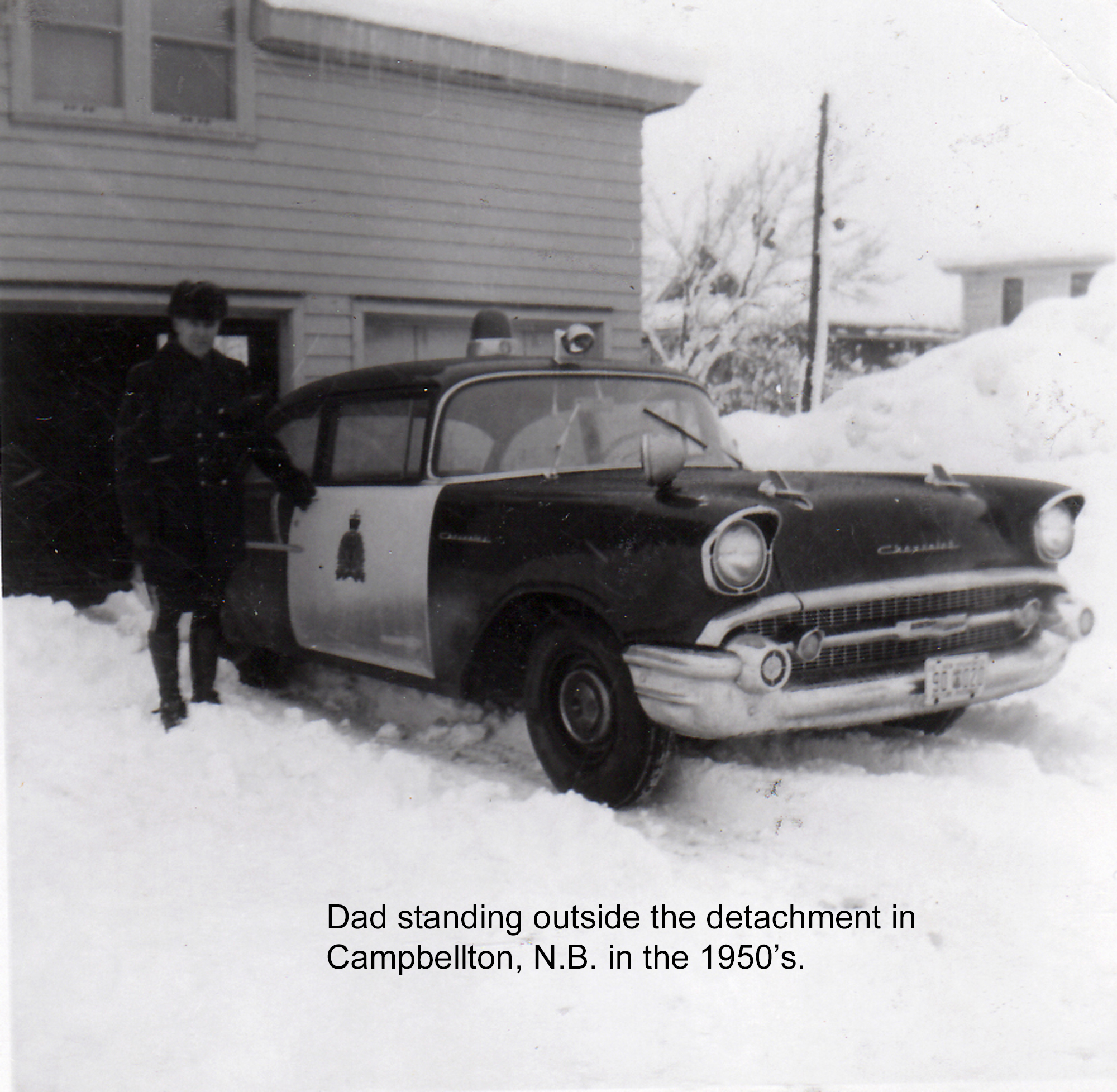
Six years ago today (July 28, 2020) my Dad passed away. He was 93 years of age. He was an RCMP officer for 34 years reaching the rank of Staff Sergeant. He served in communities in Prince Edward Island, New Brunswick, and Nova Scotia where he retired. I knew him as a quiet man who rarely spoke of his work. In 2017 when he visited my wife and me in Newfoundland I decided to interview him about his life. I made recordings and took many notes of his life growing up in Hebbville, Nova Scotia and of his life as a police officer. This is one of the stories I wrote some time after that. It is my tribute to him. He wasn’t perfect but he was my father.

My Dad, Bryce Andrew Hebb, Regimental Number 15906, joined the RCMP on September 19,1949 at the age of twenty-two. At the time of his engagement the rate of pay was listed as $3.75 per day for the entry-level third-class constable. It would rise over the next three years to a staggering $4.50 per day. He was posted to Prince Edward Island in 1950 after he completed training. One of the conditions of his engagement was that he be unmarried. 

This document further clarified he needed permission to marry and that would not be granted unless he had completed five years of service and was at least twenty-six years of age. It was for this reason, that my Dad left the RCMP in 1953 to marry my mother. He would later rejoin in 1955 and would serve until he retired in 1987. The following story is one that he told me about during a lengthy conversation we had when he visited me in February of 2017. 

Possession and production of alcohol was illegal in Canada between 1918 and 1920. It was banned beyond that period, but most provinces removed the bans during the 1920’s. However, Prince Edward Island retained the ban until 1948. The ban did not stop drinking or the demand for alcohol, and the moonshiners stepped forward to fill that demand. This story starts in February of 1951.

The sun was cracking the horizon now, a brilliant red. The stinging in his left ear was gone. It just felt numb now. Bryce Hebb pulled the buffalo hides up around his neck as he looked at Pete Jay, who was sleeping in their makeshift lean to. He too was covered with a buffalo hide. A snort echoed briefly from Peter’s gaping mouth, and he smacked his lips together. They had been sitting in the woods watching a still they had found three days ago in the woods just outside Marshfield, Prince Edward Island. Waiting for the owner to show up. 

Peter and Bryce were RCMP members who were assigned to the liquor squad at the detachment in Charlottetown. Peter was the corporal in charge of the unit and Bryce was the junior constable. They enforced the Excise Act in the province. They were constantly collecting information and conducting searches for illegal stills involved in the manufacture of alcohol. Offenders stood to have property that was used in the commission of the offence seized, receive a fine, a jail sentence or both upon conviction. Peter was from Mount Stewart, and he knew a lot of people around the province. Dad said it seemed like Peter knew everybody. Bryce liked the work, especially in the summer. He and Peter would raid a place reported to have a still, and when they finished, they would go fishing for the rest of the day. Winter was not so comfortable. 

They worked out of the Charlottetown detachment which was on Prince Street. It was a three-story building that used to belong to the Boy Scouts of Canada before being taken over by the RCMP. It also served as the headquarters for the RCMP in the province. Bryce worked on the third floor which was a bit disconcerting when it came to the fire escape measures. Fire regulations were almost non-existent in those days. There were no escape stairs and if a fire did occur in that building, there was a large rope secured to the wall which would be thrown out the window. The occupants of the building would then lower themselves to the ground on the rope. A fire did not occur during my Dad’s time at this detachment, and he was thankful for that. 

Peter stirred and looked around. “See anything.” 

“Nothing.”  Dad said. The early morning brought cool winds, and he shivered despite being wrapped in the heavy buffalo hides. 

“Well, I guess they must have caught on to us.”  Peter threw off the buffalo hide and stood up. “I guess we’ll bust up that old still and go home.”

They stopped across the heavy snow to the road walking the few hundred feet to the stand of trees where the still sat idly, hidden from view. They made short work of smashing the equipment and a few minutes later they were walking out to where they had stashed the unmarked police car. They had not walked far when they met a man walking in the road. Peter knew he was the owner of the still. They arrested the man and he confessed to owning it. The man later went to court and a conviction was registered. I am not certain what sentence the man received as my father was not clear on that, but it was most likely a fine. It turned out that this man, who they had sat in the cold for three days waiting for, lived next to the girl Dad was dating at the time, my mother. 

My father had frozen his ear during this surveillance resulting in an ear infection. He went to the hospital to have it looked at and the doctor found a hole in his ear drum. He suffered from hearing loss later in his life due to this injury. I am sure the hearing loss caused him some problems in his old age, but he was never one to complain about anything. I think he may have secretly enjoyed his lack of hearing on occasion, when he encountered those gabby people who blather on about nothing. 

I am glad I took the time in 2017 to talk with my father about his past. It seemed before that I never had time or interest, to sit down and talk with him about his life. It did not seem like it was important then and even after that conversation I did not realize its significance until he died in the summer of 2020. It was then it struck me that when we come into this world, we are a fresh canvas; each of our lives a work of art and we are the creators of that art. Yet, art is nothing, unless it has someone to appreciate it. 

Standard
Uncategorized

Frozen Scream

A policing career involves dealing with many things most people never see. Death is often one of those. You attend scenes where one or more people have died. It can be a natural death, accidental or due to a criminal action. My first death scene was an old lady who had passed away in her sleep in 1974.  A neighbor had gone to check on her, finding her lifeless body in her bed. We responded to all deaths that did not occur in a hospital setting under medical supervision.  I was assigned to stay with the body while the senior constable interviewed the witnesses.  I read a lot of Stephen King novels back in the day so needless to say my imagination ran wild as I stood watch over this poor old lady. 

That was short-lived, thank God, when the ambulance arrived and took the body to the morgue.  I drew the short and only straw, so I attended the autopsy the next day.  The medical examiner was very professional, explaining everything as he worked away on the deceased. It made the experience more interesting than unpleasant.  (But not by much 😊). 

I can’t say I ever got used to seeing dead bodies but once the initial shock was gone, you just got on with the job.  I don’t think any first responder would argue, it is the death of children that stays with you long after the scene has been finished. Whether or not you have children, the death of a child is a difficult event to cover.   The following is a poem I wrote about one such occurrence at a house fire in a small community on the north-east coast of Newfoundland and Labrador in the early 1980’s.

Frozen Scream

Smoke rose in wispy trails

From the remains of the house,

The home

We lifted the girl’s body onto

The stretcher next

To the charred roast

That was her baby brother

Her little body stiff, soot covered

Taken from a living room chair

Where she had tried to escape

Pushing back from the approaching flames

Her tiny face contorted into

A frozen scream

The weight was light but the burden

The burden of two small souls

Weighed heavy on our hearts

We placed the stretcher in

The waiting ambulance

Closing the door on

A memory that would

Wander through our dreams

Forever

Standard
Uncategorized

Four O’clock Tea

Wesleyville, a small community on Newfoundland and Labrador’s northeast coast, was one of my favorite postings as an RCMP officer. I served four years there from 1981 to 1985. People were easy to get along with and my wife, Sharon and I made many friends there. It seemed like there was always someone at our house or we were off to another friend’s home for coffee or something else. We transferred out in 1985 and sometime after we returned for a visit. We went out with friends to a dance at one of the local clubs and while we were there someone requested a song from the band for Sharon and Wayne who were ‘home’ for a holiday. That is how Wesleyville was. It was not home for us, but it felt like the next best thing. Good memories were made there.

These days due to amalgamation, it is known as New Wes-Valley. Over forty years have passed since we left that place nestled into the sea and we have made St. John’s our home. We still see friends from the Wesleyville area now and when we meet it is like we are just picking up where we left off. Transfers tend to separate the old from the new. You have every intention of keeping contact but your life in your new community gets in the way. I do regret not maintaining the ties, but I am glad for the time we shared with those people who made our lives better with their friendship.

The story I want to tell you about takes place in Lumsden, another great little community not far from Wesleyville. It was in the fall of the year, and I was working on the files I had for this area. The cool, crisp days of autumn bring the hustle and bustle of people gathering their berries, fish, and other things in preparation for winter. The sound of axes splitting wood and chainsaws sputtering through thick fog are commonplace. One of the files I had involved a minor motor vehicle accident. I had to obtain a statement from an elderly gentleman as he was a witness to this accident.

I rolled up to his door around quarter to four in the day. The missus was hovering around busily as I entered the kitchen. She ushered me into the parlour (it was an old-fashioned Saltbox home) where the old fellow was sitting on a comfortable sofa, reading. I explained why I was there, taking out my statement pad, but before I could get started, the missus knocked on the parlour door. She asked to speak to her husband, and he went out in the kitchen to see what she wanted.

I was left behind while they conversed in the kitchen. I looked around at the surroundings, the old furniture, and other antiques in the room. There were lots of pictures on the wall and as I was examining them, I noted peculiar one. It portrayed an older man with his eyes closed and his arms crossed across his chest lying in what appeared to be a coffin. I guess they did not have an opportunity to take a picture before he died. I was interrupted by the mister returning. He asked me to come out to the kitchen.

When I entered the kitchen, I was assaulted by pleasant smells and sights of the wonderful assortment of breads, cookies, cakes, and other home baked delicacies on the table before me. The mister advised me it was time for tea, and I was invited to join them. I protested politely (not too politely) and said I only came to take a statement from him. He waved his hand saying we could get that after we ate. I gladly gave in to his demands and sat into this great feed. I immediately started to help myself, but I noticed the old fellow was sitting with his hands, on his lap watching his tea. The missus was standing by his side with her hands folding waiting.

I realized at that moment that I was witnessing tradition. Newfoundland had a lot of English; Irish and Scottish ancestry and the people of this province were no doubt heavily influenced with their customs. I had read about this but never witnessed anything like this firsthand. I watched intently as the woman stood patiently until the old fellow nodded his head. The missus spun into action, picking up the spoon from the place setting and squeezing the tea bag and removing it from the cup. Then she added some sugar and some milk and stirred the mixture. She laid the spoon on the saucer and stood back waiting with her hands folded.

The mister sat tolerantly until she finished and then he picked up the cup bringing it to his lips. He sipped some tea, savoured it and with a quick nod of approval he laid it back down. Then the missus buttered some biscuits for him and cut up a bit of hard(cheddar) cheese to go with it. Then she went to her place and fixed her own tea.

Well, that was certainly something for a young husband, like me, to see. This old guy was the king in this household. Quietly I paused, realizing I had observed a valuable lesson before I continued with my very enjoyable luncheon. I thanked the missus once finished and I returned to the parlour with the old fellow to take his statement. I could not stop smiling as I drove back to Wesleyville to finish my shift.

I went home and told Sharon about my day, including in detail, my encounter with this older couple and the afternoon tea. Sharon was quiet as I described this wonderful example of married life. When I finished, she smiled, and rising from her chair she went to the kitchen. Thinking my story had the desired effect, I sat back contented to wait for her return. A few moments later, I heard the back door open, and Sharon cheerfully sang out.

“I’m going to Gert’s for a visit. See you later, honey.” 

Without making any comment on my story, she had made her point. Later that evening as I sipped on a cup of tea (which I made myself), I realized some traditions were never coming back.

Standard
Uncategorized

The Siren

Another young male police officer was killed today.  A civilian was also killed as well as a female police officer being seriously injured.  The incident occurred in a Montreal neighborhood. The suspect was also killed.  The female police officer was sent to hospital and thanks to hospital staff her life is no longer in jeopardy.

Yesterday, two RCMP officers in Melville, Saskatchewan were seriously injured after being shot while attending a report of assault. They are presently reported as being in stable condition. I imagine from my experience that in both incidents the attending officers did not know completely what they would encounter when they arrived on site.

These incidents caused me to recall returning to Newfoundland and Labrador after attending the funeral of my nephew, Devon Northrup and his partner Morgan Russell in Ontario. They were both with the South Simcoe Police Force and were killed attending a family disturbance in Innisfil, Ontario on the 11th October 2022. My wife, Sharon and our granddaughter were with me and when we returned, I became aware of a wreath laying ceremony at the Monument of Honor in Conception Bay South (CBS) being held on the morning of October 27th, 2022.  The wreaths were being laid in honor of the four Canadian police officers who had been killed in recent months of which one was my nephew, Devon.   I attended this ceremony along with a small group of police and military members.  It was an emotional affair bringing back memories of Devon’s funeral which I had just attended.  During the ceremony, almost as if on cue a police car with sirens wailing and lights flashing passed by on its way to a call.  That pinched my heart, so when I came home, I sat down at the computer and the following poem resulted:

The Siren

Fallen leaves

Soaked with morning frost

Glistened in the bright sunlight

Photos of four fallen police officers

Killed these past few weeks

Watched with frozen smiles as a

Small crowd of retired and serving police

Armed forces personnel and public servants

All stood squinting in the daylight

Around the Monument of Honour

A retired police officer,

His features aged from when

I knew his younger self

Led the proceedings

Followed by the chaplain

With some kind words and

The Police Officer’s Prayer

A police siren wailed

As she read the prayer

Officers on their way to a call for help

Perhaps as unaware of this service

As they were to what would happen on the call

Yet that lonesome and urgent sound

Paid tribute to the deceased

Reminding those present

The work they did and

The work still being done

Is important

Standard
Uncategorized

The Last Shift

It has been a heartbreaking week for those in police services as two police officers in Ontario lost their lives in the line of duty. Cst.Tarun Bali was struck by a stolen vehicle driven by an 18 year old man who had escaped from the hospital where he was being assessed under the Mental Health Act. Cst. Bali was seriously injured and later died at the hospital. He had two and a half years service and was posted with the James Bay detachment of the Ontario Provincial Police. Cst. Marc Pinizzotto, an 18 year veteran with the Toronto Police Service was shot and killed by a nineteen year old man during a raid on an apartment building tied to an investigation into recent shooting at the American consulate.

My nephew, Cst. Devon Northrup and his partner, Cst. Morgan Russell of the South Simcoe Police Force were shot and killed while attending a family disturbance in Innisfil, Ontario on 11 October 2022. The suspect, twenty-two year old, Chris Doncaster, then shot and killed himself. Devon’s parents, my sister, Heather and her husband, Ron and their family were deeply affected by his death.

These officers paid the ultimate sacrifice in the execution of their duty. Their bravery will always be remembered but it will be forever mixed with sorrow. The following is a poem I wrote after Devon’s death. It is a tribute to him and to all those in uniform who work everyday to keep this country safe for us.

The Last Shift

He stood strong and tall

Checking his uniform

In the mirror

A photo of his uniformed parents

Watched as he brushed

A speck of lint

From his pants

Satisfied he started for

The door then pausing

He turned and walked

To the kitchen table

Where his partner sat

Drinking coffee

He kissed her and

Flashed her that big smile

That smile that said

‘I’m happy.  Life is good.’

Then closing the door

He left

Standard