Life is not always warm and gushy. Perhaps as a police officer, you learn that more quickly than other occupations. Generally, that realization comes right after you leave the training academy. Police training involves simulated situations where the tasks you are taught are managed in a structured manner where everything seems to fit. ‘So, that’s how it’s done.’ The instructor would say. Simple enough, but it does little to prepare you for what happens when you get to your posting.

Exercises at the training depot were done with a partner or a group and you make decisions based on everyone’s input. When you get out in the field (on the job) you quickly learn what the phrase ‘fly by the seat of your pants’ means. You discover you are the lone person working especially in small communities and outports. That has been a good part of my experience in policing in Newfoundland and Labrador. Often, I have found myself in situations where the nearest backup is more than an hour away.

What do you do? When you are single the answer is perhaps a little cloudy, but when you meet someone and start a family, it is clear. Your responsibility lies with keeping safe and going home at the end of your shift. I have always tried to face every situation as best as possible but there were times that I backed down, and probably others when I should have backed down, but I remained. You plague yourself whether you were right or wrong, but it was your decision, so you accept it and put it behind you.

I was stationed in the detachment of Ferryland, a small community on the east coast of Newfoundland and Labrador, from October 1974 to April 1976. It was a three-person detachment which covered around eighty kilometers of road and included communities like Renews, Cappahayden on one end and Mobile and Witless Bay on the other. It was a cool night in October 1975, and I was working the night shift alone. I was twenty-one years old. I was patrolling the highway between Tors Cove and Mobile when I came up behind a blue Dodge Dart which was taking both sides of the roadway.

I engaged the emergency lights and slowly this vehicle pulled to the side of the road. I tried the radio before exiting the vehicle and there was no signal. I was in a dead spot (an area where no radio communications were possible). This was common in the province. You might travel a hundred feet and get a signal however, I was not able to do this, so I jotted the plate number down on my night sheet. If something happened, then at least the investigators would have something to go on. I could see one person sitting in the vehicle, patiently waiting for me, as I put my hand on the door handle.

A cloud of fog escaped my mouth as I exited the police car and approached. The quiet of the night was broken only by the swish of the trees moving with the light wind. The highway was deserted. I shone my flashlight on the back seat as I neared the driver’s door. Nothing there. The driver’s window was open, and wisps of alcoholic fumes reached my nostrils, as my light shone on the driver. He was quiet as he stared back at me with his watery eyes. Closer examination revealed eyes so bloodshot they could easily pass for a map of a heavily populated area.

“Can you step out of the car, please.” I spoke with the tone of authority like my trainer; Brian Campbell had told me. A tone that let them know who was in charge. The man shut off the car and removed his keys. The door wobbled as he followed my directions. My initial observation was that the man was stocky, but when he stepped out, I was not prepared for what I saw. He stood about six feet tall but that was not the remarkable thing about him. I had often heard the line, ‘he was as broad as he was tall’ and thought no one could ever meet that description. This man proved how completely wrong I had been in that thinking. He had to be every bit of three hundred pounds on a conservative estimate. I realized I was no match for this cousin of Godzilla, and I would have to resort to trickery. I breathed deeply trying to cover the unease in my voice and said,

“Why don’t you come back to the police car for a little chat?” 

To my surprise he started towards the police car with its lights flashing, warning no one. When he got to the rear of the car he stopped and fumbled with his keys and started to open the trunk. Warily I let him proceed. When the trunk opened, I could see an open two-four of beer (Labatt’s 50) on the trunk floor. He quietly reached in and got two of the stubby bottles and put one in each of the side pockets of his suit jacket. Stubby bottles for a stubby man, I thought wondering what would happen next. I guess, he thought our chat would be more of a social occasion. Nothing like a couple of beer when you are talking to the police on a lonely road in the middle of nowhere.

This was something I would have to deal with later, I thought as the man closed the trunk with a clump. I felt relieved as he trudged to the police car. I directed him to sit in the front passenger seat as I wanted to see what was going to happen to those beers. Surprisingly, he sat in the car without any fuss, and I jumped in the driver’s side. I quickly put it in reverse turning it towards Ferryland. I stepped on the gas and brought the cruiser up to the speed limit. I quoted the Breathalyzer demand from memory as soon as I put the car in motion.

The man exploded into a tirade of verbal abuse, calling me every name in the book and ‘gentleman’ was not on those pages. The lights of Tors Cove were in the distance as I nudged the speedometer a little above the posted speed limit. A few minutes later the man became silent. I could hear him rummaging in his pocket for a beer. All the cursing had apparently made him thirsty, I guess. Having retrieved the bottle, he now was trying to use the seat belt fastener to open it. We are talking the dark ages here. Long before seat belt regulations and twist off caps. I snatched the beer from his hands and put it under my seat, well out of his reach. A barrage of non-dictionary terms spewed forth from his lips. Suddenly it was like a light snapped on in his head when he realized he had another beer in his other pocket.

He pulled out this bottle and was again attempting to use the seat belt opener when I deftly seized it, placing it with its mate. I could hear an uncomfortable wail as this Goliath started to cry. Yes, cry. Tears of rage streamed down his cheeks as he blared out descriptions of me that even my own mother could not love. He calmed somewhat, still muttering but low enough for me to radio my situation and request a Breathalyzer technician. I was still about a half an hour from the detachment when he accused me of not being a Newfoundlander. I said I was not, and he said,

“That’s right because you haven’t got the guts to jump out of this car right now.” 

The car was travelling at just above the speed limit, so I took this as only his raving. I replied, “Well, if you want to jump out at fifty miles an hour, that’s your prerogative.”

The shock jarred me when I heard the click of the door opening and saw him start to get out. I grabbed his coat and managed to pull him back in and he shut the door. The blood was flooding my veins like Niagara Falls, as I warned him not to do that again. Shortly after, he tried again. Again, I grabbed his suit coat and managed to get him back in and get the door closed. Now I was the one shouting at him to stop this crap. It must have influenced him as he did not say much as we drove through Cape Broyle and up Cape Broyle hill. My heart rate was slowing down, and I thought the worse was behind me. I was at the top of the hill when I heard the door open again. I reached for his jacket, but I felt the material slipping from my hand as I slammed on the brakes.

The car slewed to a stop and the man rolled out of the car and was gone. There was only a small shoulder on the side of the road which dropped off to a treed valley below but no sign of Baby Huey. God, he’s dead I thought as my heart began to beat with a sledgehammer. I leapt out of the car and ran down the hill. I fully expected to find a rotting corpse with bulging eyes and lolling tongue (I read a lot of Stephen King at the time) lying at the bottom. Thankfully, all I found was a blubbering hulk staggering around urinating on a new growth of fir trees. He was holding his manhood with both hands like a mountain climber holding a safety rope, sobbing uncontrollably.

I managed, with a great deal of effort, to get him back to the top of the hill. This time I placed him in the rear seat and as I closed the car door, a taxi driver had pulled up behind me. It was the only other vehicle I had seen during my ride with this creature from the black lagoon. I explained to the driver my circumstances and he agreed to accompany me to the detachment. He sat in the vehicle and the other person in the taxi drove it behind me. When we arrived at the detachment, I thanked the taxi driver, and I brought this man into the office where I presented him to the Breathalyzer technician. Relief washed over me as the technician, Corporal Wayne Collicutt explained the procedure to this man.

“I am not going to take no fucking Breathalyzer test.”  He was adamant so I did not bother to explain that he had used a double negative.

Wayne told him he would be charged with refusing the Breathalyzer test. I prepared a promise to appear and presented it to him. I offered him a ride home. We did have a cell at the detachment, but we did not have any guards available. That would have meant me sitting with him overnight, so the best scenario was to drive him home. Wayne came with me as we began the drive to Bay Bulls where this man lived. The trip took about an hour, long enough for Captain Grizzley to do a repetitive critique on my driving abilities, as well as my future as a police officer. We dropped him off at his address and he left us with a middle finger thank you.

Looking back, I find humor in this incident, but it was a long time before I did see the funny side. I could only see the ‘what ifs.’  What if he drank the beer? What if he had been killed? I guess the ‘what ifs’ I was thinking about belonged to other people. People who were not there, who did not experience this firsthand. They are seldom there when trouble raises its fiery head. No, the only one you must depend on is yourself. Your decisions must be made in seconds and sometimes they might not be the prettiest solution but if it works why beat yourself up over it. Learn from it and move one. One less impaired driver on the road, now that’s Titanic!

Uncategorized

A Large Decision

Gallery
Uncategorized

Good Breeding

Early in the job of policing, you learn you are not always the strongest, the fastest or the smartest person. There are times when you cannot wade in and do things the same old tried and true ways. Sometimes you must improvise to get the job done.

In the early 1980’s I worked in a three-person detachment in the community of Wesleyville now known at the town of New-Wes-Valley. It is situated on the northeast coast of Newfoundland and Labrador. The detachment area encompasses the communities from Musgrave Harbour to Trinity on the Bonavista North Peninsula. Frequently we worked alone. If you needed backup, you called on the off-duty members on the unit. If they were unavailable the next option was to call either Gander or Glovertown detachments. Depending on where you were in the area that could mean anywhere between thirty to ninety minutes or longer for backup to arrive. Given those odds, you often had to deal with any situation the best way you could.

Fortunately, most weekends there were two members working. On those nights you tried to contact as many of the local troublemakers as possible. This generally meant, stops for traffic offences and impaired drivers, and checks for illegal drugs and offences under the liquor control act. Some people might say, why bother someone for drinking a beer in public or smoking a joint. You should be out looking for people committing more serious offences. Yes, they are minor offences, and the consequences are minor as well, but a sizable percentage of offenders are often under the influence of alcohol or drugs when committing the serious criminal acts.

Stopping someone for an open beer or a joint would be a buzz kill for them. More importantly, it will most likely change their actions for the night. They might not be so interested when someone mentions about committing a break and enter. They have already been charged once that night so why risk it again. I like to think this type of enforcement has that kind of preventative measure behind it. Besides, word gets around that the police are on the move and that is a good preventative measure as well. Furthermore, when I was a kid, the police chased me for open beer, so I would not have wanted the youth in my policing days to feel left out. I have always been an equal opportunity kind of guy.

All this brings me to a Friday night in the early 1980’s when I was working with Constable John Butt. There was a teenage dance at the Badger’s Quay (a community about a ten-minute drive from Wesleyville). We regularly patrolled these events to show our presence and check on any unacceptable behaviour. Often, these dances were attended by fellows in their twenties who had not taken the chance to grow up. Frequently, they were the source of trouble on these occasions. We pulled into the parking lot noting two older fellows standing by the rock hill across from the back of the dance hall. One of these fellows was one of our regulars, especially when he was drinking.

As we approached the two, we noted a dozen box of beer, and they were drinking the beer right there on the side of the road. We stopped the police car and immediately our regular took to the hill. The other guy stood there with the beer case and John went to him. I raced up the hill. I was breathing heavily as I reached the top of the hill and cursed the extra chicken leg I had for supper. I still had the guy in my sights, so I continued. There is something about a chase; you cannot seem to give it up once you get caught up in it.

There is a little voice inside saying, ‘Can’t even catch a drunk. Boy, time for you to hang up the twinkies. Stubbornness keeps you going despite everything else. The terrain had rocks jutting out, holes and boggy parts which made the running in the dark a bit hazardous. I began thinking this fellow was going to get away when inspiration struck. I opened my mouth and barked. Yes, I barked like a dog, hopefully a large dog.

Well, at that moment this guy took a worried look behind but unfortunately for him, he kept running at the same time. He tripped and fell into the bog, and I caught up with him. I got him to his feet and both of us stood facing one another, doing nothing but breathing heavily for a few moments.

Finally, between breaths he said, “Gees, I thought it was a German Sheppard.”

I smiled as we walked back to the police car thinking the success of this chase could be attributed to my good ‘breeding.’

Standard
Uncategorized

Sing

Policing often involves struggles, physcial and mental everyday you go to work. Some days you fight to wrestle a drunk from behind the wheel and other days you battle with advising parents of the death of their child while waiting for them to answer the door. Without a doubt, this is one of the most difficult duties a police officer does. This poem goes out to all those who have experienced this part of the job.

Sing

Sing a song

Oh, to sing a song

To make people feel,

Happiness, love or

Just some pleasant emotion

Making everything right

This, I thought as I wrestled

The drunk to the ground

He had run over a teenaged girl

With his high-wheeled truck

A girl who wanted to be a nurse

Her parents were proud to say

Now, an empty dream

He was wrong but the system

Would work in his favor

Despite his struggles with me,

The lowly cop, who would

Be to blame.

You should have this

You should have that

His lawyer would say

The girl would be forgotten

I think, as I knock on her parents’ door

If only, if only,

I could sing a song

Standard
Uncategorized

A Private Moment

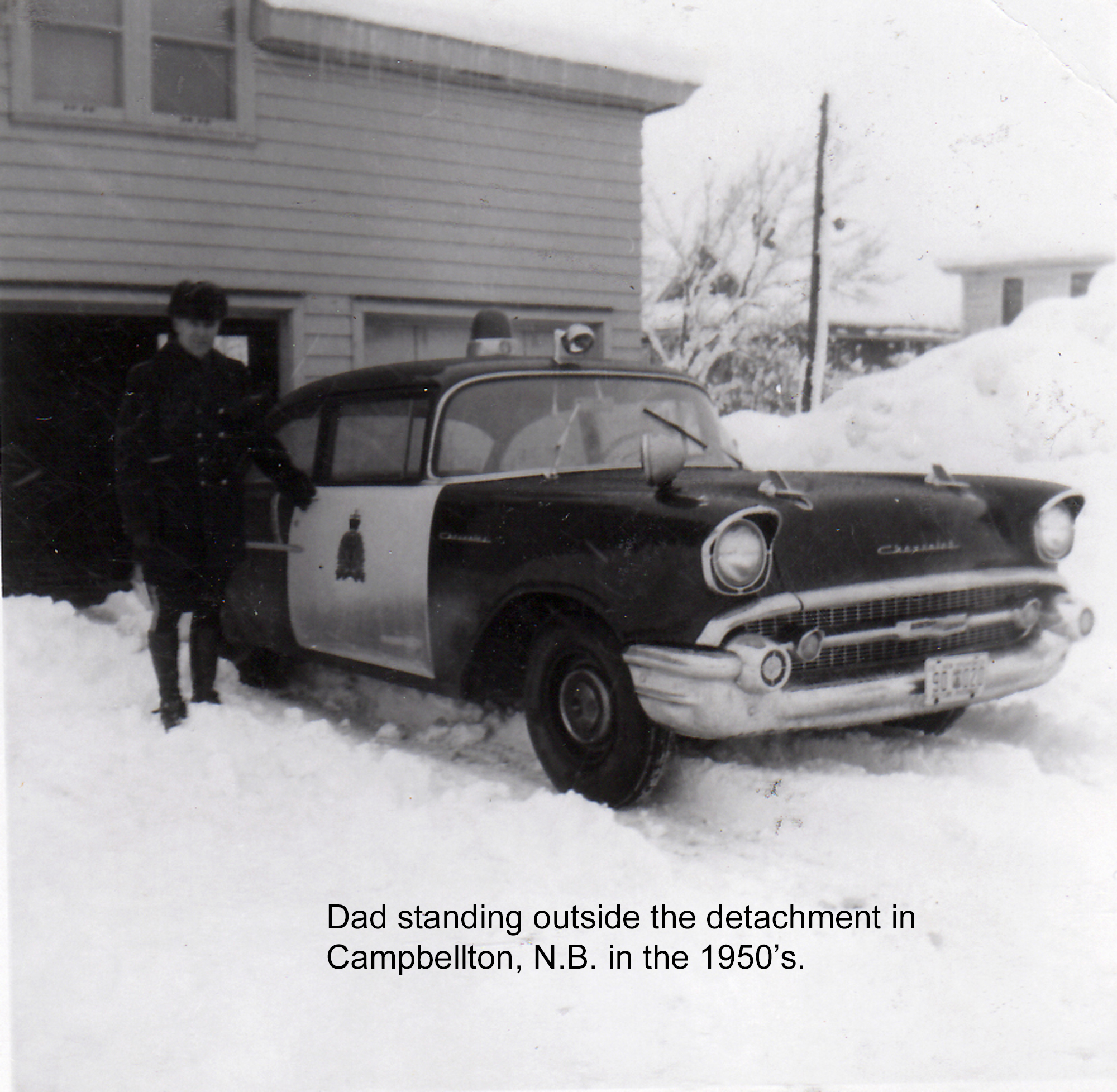
When I was a boy of maybe eight or nine years old in the early sixties, my father took me out in the police car.  This was when we were living in Sussex, New Brunswick and while many of my young memories have slipped away, this one stayed.  It was just me and my Dad which didn’t happen that often when you had three other siblings so it was special to me.

A Private Moment

When I was a small boy

I rode with my father in

A police car and listened to

Him as he rhymed off the

Names of the cars we saw

That’s a 59 Ford Fairlane, there’s

A 57 Chev, a 54 Dodge wagon and

Look a brand-new T-bird

I didn’t know any of those names but

I knew a few birds like robins and sparrows

Though I never heard of a T-bird

He was in uniform when he

Took me on that ride

A thrill for me because

Cops were the good guys

And my Dad was one

It was a moment between

Father and son, privately shared

I grew older, a teenager, when

Having a cop for a Dad, was not cool

I could not deny he was a cop, but I denied

I was like him; I would not tell on my friends

They included me in their drinking

And a few other unsavory things

Things I shall not mention here

Cops were pigs, that is what they

Said and I let it go just to

Gain the trust of those people

People I don’t even remember now

I regret that, because he wasn’t

Just a cop, he was my father

I was never like him but

When I became a cop

It was then I understood

How much we were the same

Standard
Uncategorized

Monster

It’s that time of year again when the danger of wildfires is ever present. Many of us in this country live near wooded areas where we enjoy a variety of activities. Camping, fishing, hunting, hiking, photography or just enjoying the peace of nature are enjoyed by many in Canada and so it should be. However, this can quickly change, endangering the safety of the environment as well as the people, property, and animals who live in or around our forest. A fire can start by accident, carelessness or in some cases intentionally. Last year the people of this country suffered tremendous loss due to fires. It was the second worse wildfire season surpassed only by those in 2023. Over seven million hectares of forest land was destroyed impacting communities and their economy.

In the province of Newfoundland where I live, the most serious fires were in Conception Bay North affecting several communities there destroying and damaging 203 structures and displacing hundreds of residents. Last year while reading one of the news articles on these fires, it reminded me of a wildfire in the Grand Falls, Newfoundland I attended when I was a young member in the 1970’s. Grand Falls was no stranger to wildfires and this was one of my first experiences with this type of castastrophe. The location of this one was on New Bay Road and fortuneately for me there was an old firefighter on the scene when I arrived. He had seen more of these fires than I ever would. The following is a poem I wrote about this experience.

Monster

The tires crunched on

The gravel road as I

Rolled up behind the

Fire truck blocking further access

Closing the door of my cruiser

I walked through the

Heat to the fireman

An older man with

Eyes of experience

Watching the fire

Smoke curled low and high as

Slowly the blaze devoured

The brush and trees in front of it

Some tall giants falling

Splashing embers silently in

The roar of crackling wood

Hypnotized by this scene

I stood there in my youth until

The chief, dressed in bunker gear

Touched my shoulder

I turned to face him as

He spoke calmly

We need to move back now

We backed down the

Road about a hundred meters

Moments past as the beast

Licked the blood from its lips

Before rising into a gigantic

Ball of orange blasting us

With its heat before swallowing

All oxygen in the air

Surrounding it as it

Rolled across the road

Where we had stood

Consuming, destroying

Standard
Uncategorized

Trail Blazers

I wrote this poem in late 2024, the year the RCMP marked fifty years of women in the force. They entered a male orientated world where they were not always welcome. I came to know some of those members during my service as well as many other fine female officers. My sister, Heather Northrup followed their example and was a member of the first co-ed troop in 1975. She was one of the best. (Please note I may be somewhat biased here). All these women made and continue to make inroads in the policing world and we are better for it.

Trail Blazers

They were young, looking

For adventure when they

Graced the grounds of depot

Nervous because they were

The first and they would be

Judged, some judgements made

Before they started

Their uniform designed by

A man’s image made them

As different as they were

Standing in formation in

The drill hall

Tested in every area

Yet the question hung like

A sign over every door

They entered

Could they do the job

They passed through the

First step, training and

Then onto the field where

The real proving began

They struggled every day

Their failures highlighted

Their successes downplayed

Despite this it was heads up

Facing each moment with

Courage and determination

Now fifty years later they are

Recognized as the ones

Who wore the red serge

Doggedly leading the way for

All those others that followed

Their efforts showed others

It could be done and

Their contributions would be

Remembered as they had opened

The doors of Respect                

Standard
Uncategorized

The Oath

Sgt. Joe Sobel at Remembrance Day 2011 in St. John’s, NL

I swore an oath that August day

So many, too many, years ago

To perform the duties expected of

A police officer in this country

I swore to do these duties without

Fear, favor, or affection of or towards

Another person and I affirmed this with

So help me God

I was young and I skimmed over

These words when I signed

The document with a theme

I did not fully understand

It would take years to realize

Despite these words I would experience

Fear, loathing, hate, and other

Emotions from the darkness

I would understand the perfection

Everyone wants is unattainable as

We are imperfect beings

Living in an imperfect world

People do not like to be told

They are wrong and lash out

At the conveyors of that message

To reverse their perceived abuse

Police actions video-taped and judged

Before any court has a chance to convene

Convicting with little evidence and

Showing superiority over the lowly blue

Still when there is trouble they reach out

To those in uniform to take care of it

But do not do it wrong and

Bring it back wrapped up in a bow

Years after I left that suit behind

I watch the news and feel sorrow for those

Still working to maintain law and order

Only now I fully understand that oath

It is swearing to do the impossible

To strive for unachievable perfection

Being set up for most certain failure and

Signing nevertheless on the dotted line

Standard
Policing

Will You March For Me

Will you march for me?

By Wayne Hebb

I marched through this country

Keeping peace, maintaining the right

For you to be safe and free

Sometimes with a gun or with fists

Scars, maybe one or two

Would not stay in the past

Now, that I am through

My time comes at last

When they play last post,

Sending me home with dignity

The thing I want to know is

Will you, yes you, march for me

Standard
Uncategorized

Late Night Thoughts – Garden of the Mind

I was in the yard a few days ago, digging the flower beds, cleaning up the debris left from the late fall and winter, spreading mulch, just trying to make it look presentable.  When I am working like this, I often think about things in my past and roll them over in my mind.  Perhaps I am doing the same with my brain as I am doing with the yard.  The following story is one that came to light during my tillage of yard and soul. I have changed the names and locations due to the sensitive nature of this matter.

The boy came up to me as I entered the gym of the Carlton Elementary School.  A few days earlier, I got a few of the members of detachment to join me for a game of floor hockey with the students at this school as part of the Police week celebrations.   The school was in the small town of Carlton which is about a half hour from the RCMP detachment located in the town of Bufferton which is responsible for policing in this area.   The boy was about nine-years old and he was smiling at me as he said,

“Hi Constable Hebb.  I’m Ronnie.  Do you remember me?’

“Why, yes, I do, Ronnie.  How are you doing?”  I said without hesitation, while I searched my memories.

It finally clicked that he was a victim of abuse I had investigated about two years prior.  I got the call on a cold day in March 1986, the day after my birthday.   I am a believer that something special happens on your birthday and while this report was not on my birthday, I think the incident happened on it.  Ronnie’s mother had cut him with a razor blade.  It certainly was not special because of that, rather it was the message or lesson I learned because of meeting this child.  The young boy standing before me was shy but had come out of it when he recognized me.  He was excited to see me and I do not know why, because when the police were involved in your life, it is most likely not a good memory.  We were getting ready to start the game and not knowing what to do, I took off my watch and I gave it to him.  I asked him to look after it for me while I played in the game.  He looked at the watch and then back to me and swore he would take good care of it.   He ran off to the side where the other students were gathering to watch the game.  Perhaps I could stop here, and you might think, what a nice thing to do, and then you would include that in your frolics down your memory lane.   Unfortunately, I do not know when to shut up when I am ahead, so I will continue.

I started the investigation by interviewing witnesses to gain information and finally I felt I had enough to have some degree of understanding about what happened. The boy lived with his mother and younger sister in an apartment in one of the low-rental housing areas which were nicknamed Section One and Section Two.   He and his family lived in Section One.  His mother met me at the door.   She was a single mother and there was no evidence of even a remote fatherly interest in this little family.   She was on social assistance, welfare it was commonly referred as, and the stress of raising two children on her own had driven her to alcoholism as well as searching for love in all the wrong places, to coin an old phrase.   She was combative at first, saying that I was not talking to her son without a lawyer, but I talked with her and after a while she reluctantly agreed to accompany me to the detachment office for further investigation.   Once at the office, I brought Ronnie and his mother into one of the interview rooms and as they sat down, I could see Ronnie had three small cuts, about an inch in length, on his cheek just below his left eye.   Some other members were assisting me, and they updated me with the information they had obtained.  The mother was placed under arrest for assault causing bodily harm.  She told me that Ronnie’s injury was the result of his getting hit with a snowball and she denied anything about razor blades being used.   She was later remanded and placed in the detachment cells to appear in court on the following morning.  

Social Services had arranged to have Ronnie’s grandmother look after the children until they could sort things out.  While we were waiting for the grandmother to arrive, I gave Ronnie and his sister a drink and some cookies I found in the coffee room, as well as some paper and pens so they could do some drawing.   Before their grandmother arrived, they came out to me and gave me their drawings.   They both had drawn a house and Ronnie’s was quite big with a small door and too small windows near the roof.   No doubt some psychologist or behavioural expert could tell you what mental processes were at work, but I just saw a child’s drawing of a home.   They both wanted me to have these drawings and I accepted them with a smile.  It was their gift to me, I do not understand why they wanted to do this for me, the man who arrested their mother, but I kept them all these years.   

When Ronnie’s grandmother arrived at the office the children were interviewed in her presence.  Initially Ronnie had denied the existence of the razor blade, insisting, like his mother, that his injuries were caused by him getting hit with a snowball with ice in it.   Now with his mother no longer present, he related he had been hit by a snowball and when he came to his mother for help because his cheek was red and swollen, she used a razor blade on his injury.   His mother, in her drunken stupor, got the razor blade by breaking open a disposable plastic razor.  Ronnie told us his mother had thrown away the razor blade, but she had put the remainder of the plastic frame in the pocket of her housecoat.  A search was conducted of the house and the plastic remnants were found in the house coat as Ronnie had described.  I do not remember if the razor blades were found.

The matter went to court and the mother plead not guilty and a trial followed.   The star witness for our case was less than stellar on the stand.  Very much so.  I can definitely say, it wasn’t the only time that I had seen a witness chew gum while giving testimony but it was the first time I had ever seen one pull it out of her mouth and swing it around on her finger.   And…she did it more than once.   The defence lawyer was able to convince the court that the mother’s actions were not assault but a misguided attempt to relieve, what she thought, was pressure on her son’s injury.   I can accept that I guess, the court has to insure it gives the accused the benefit of fairness in assessing the evidence, but I always wonder where that benefit is when it comes to victims, especially children.  

Yet, that is it, isn’t it?   There are no rules as to what parents you get when you come into this world and there are no requirements for being a parent other than the physical ones.   You cannot drive a vehicle without a licence from the government, but you can raise a child, a delicate human being, without any conditions.  That is an old thought and I am sure you have heard it before, but it always gives me reason to pause.

Now back to the floor hockey game.  We played valiantly against the grade six students, but they outscored us in the end.   The children cheered for their fellow students and for the willing losers and it was one of the better memories of my policing life.  Except, that after the game, I looked for Ronnie and then he showed up holding my watch out to me and I felt bad.   You see, when, I gave him my watch I had this thought that maybe I would not get the watch back.  It was only a forty-dollar Timex so I do not know why the thought even entered my mind.   Yet, I do.  Police officers are suspicious in nature and the more experience you have in policing, the more suspicious you become.   This was a child and the only reasons I had this thought was because he was poor and because of his upbringing.  It was only brief but so is saying the F-word out loud at a church service. 

 I thanked Ronnie and patted him on the back in front of his classmates.  It was a big thing for him, to have held this watch for the policeman.  A lot of young boys back then, (not so sure if that is the same today) had an image of the police as the hero in blue but on that day, I silently trashed that image with a single thought.  A thought that has never been spoken or made audible but shame rings inside my skull all the same.

My shame has faded now but I learned a valuable lesson from this little encounter. Everyday, millions of thoughts are processed through our brains and not all are good or helpful, but we are in control. We direct what we act on. We are all imperfect people living in an imperfect world expecting perfection, but that perfection is different for each and everyone of us. Each day we must pay attention to the notions occurring inside our heads. Examine them carefully, for the lazy gardener reaps many weeds.

Standard
Uncategorized

Late Night Thoughts – Suit of Blue

Suit of Blue


The old man hobbled over to the park bench and sat, leaning his cane against the metal arm rest.   He closed his eyes, sighed, and breathed in.   Children were riding their bikes, skateboards and scooters and even more children were on the swings and the monkey bars in the playground.  He smiled at the sounds of life around the bench where he rested.  Trees full of leaves offered shade from the strength of the early June sun.  Parents sat or stood watching their children and some scolding the little ones for being a little too active.   Music played from the snack bar a hundred feet away from him and folks and their little ones were coming away with a plate of fries, a hot dog or just a big old, double scoop ice cream cone.  He felt the sun on his face, and he leaned his head back, awash in the idyllic day.

His eyes still closed, he daydreamed of the past, his past.   He had been a cop, a police officer but he liked cop better.  It was less formal, more down to earth, but then, who but anyone who had worn the suit of blue, would ever analyze this.  He had retired during the summer of 2020 with twenty-seven years.  Thirty-one years ago.  He would have worked longer but the events of that year were just too much.   The bush fires in Australia, the corona virus pandemic, the Black Lives Matter movement and the second wave of the virus, two weeks after the protests, erupting into three million cases in the United States alone and the death toll rose over 300,000.  To call it tumultuous would be an understatement.  

Tensions rose in early January when an American drone strike killed Iranian security and intelligence officer, Major General Qasem Soleimani, followed a couple of days later by Iran pulling out of the 2015 nuclear deal.  A Ukrainian Airlines flight 752 was shot down by Iran a few days later and all 176 passengers and crew, 57 of whom were Canadians, died.   The possibility of war was on the minds of many North Americans as this played out.   It fizzled out by the end of 2020 with a change of leadership in the land of the free.  Joe Biden won the US presidential election in November of 2020, but it was March of 2021 before he was inaugurated because the former president, Donald Trump, refused to leave the oval office and relinquish command.  It finally took a Supreme Court order served directly by the Attorney General and the presence of armed troops for Trump to realize the time for his rule had passed.   Trump supporters rose up in angry protests resulting in the killing of hundreds of people, most of them police officers as they were targeted by the protestors.  Targeted because police became the focal point of public hate.

During an arrest in May 2020, a police officer, had knelt on the neck of a black man for almost nine minutes, snuffing out his life while the officer watched with his hands in his pockets.  Horrible.  The old man shook his head.   It was not George Floyd who had changed the world, you could not put that on him.  It was this piece of shit, in uniform that was responsible for the change.   Not entirely, it had been coming for a while, he was the straw that broke the camel’s back.   The job, that everyone knew how to do right except the ones doing it, was becoming obsolete.  No one liked to be arrested or to be detained, so often, you had to struggle, to fight, just to earn your pay cheque.   Arresting a non-compliant person cannot be made to look pretty by any stretch of the Imagination.   Even when justified, it never looked swift and smooth like in the movies, and perception made you the bad guy.  People wanted pretty.

The George Floyd incident brought all the recent deaths of black people at the hands of the police to a head.   People could not take it anymore and they started protests, protests which were supposed to be peaceful, but erupted into violence, with people and police being killed and injured in the name of peace.  There were many who blamed the violence on white supremacists and that might have been true, but it was not all the truth.  The truth was never laid out as very few were charged or found responsible for those crimes.   Hate smoldered in the eyes of protestors as police were tarred as racists, bullies, liars, and all things negative.  Several police officers tried to quell the hatred by kneeling with the protestors in a sign of solidarity and that did sway some in their thinking, but not enough, as ‘defund the police’ surged across the US and other countries.  The media reported police brutality was rampant and reported incidents daily to prove this.  To stamp it out, to get rid of it, defunding racist law enforcement organizations became the only answer and the only logical next step was to disband the police.   ‘We can do it better’, was the slogan on some of the placards the old man had seen while holding the line in front of businesses.

It was shortly after that duty that he put in his retirement papers.   It was July 2020.   Officers who had retired previously told him the day would come when he would know it was time.   It did; but it was not an instantaneous thing that flashed into his head.   He had known it for a long time, yet he hung on until, like the protestors, he could not take it anymore.   He could not take the hatred, the disdain for a profession which was built on mottos like Serve and Protect.   His official date had been October sixth, but he had taken the remainder of the leave he was owed so he finished up on August the eighth.   The protests were still happening in many cities but with less looting and violence.  That may have been due to the protestors anger being quelled, or it might have been due to many of them getting sick with the virus due to lack of social distancing practises.   Either way, he left his gun and badge on his supervisor’s desk, signed his termination papers, and walked out the door.   He was done. 

Shortly after his retirement it started.  Force after force was disbanded in the United States and in Canada until 2030.  By then only a few policing agencies remained yet with vastly reduced operating budgets and limited duties.  Those in power formed Community Response Teams (CRT) and resourced them with people with education in mental health and social, poverty and gender specialists.  Civilianized police organizations, CPO’s, complemented the CRT’s and they were comprised of unarmed, non-uniformed personnel with skills in de-escalation techniques.  Police officers were refused applications unless they underwent a six-month decontamination process which supposedly eliminated all previous police thinking.  Not many opted to go through this and out of the few that did, most failed miserably and either left or were fired.

The new system was welcomed with open arms by all the civil liberties groups and they were included in the civilian oversight of these new agencies.  It was all congenial at first and it seemed even the criminal element was co-operating, or at least holding back to see how things played out.   The leaders, despite their strong dislike of Donald Trump, were unrelenting in their Trump-like support of the CRT’s and the CPO’s and how they were an overwhelming success over the old way of policing.   Many police officers were out of work and moved on to other things, but some did speak out against the new order only to find themselves and their families targeted with hate mail, vandalism, and violence.  Soon they stopped speaking and faded into society.   Now, twenty years later, few even spoke of their former careers, while the leaders of the new world of public order, continued to profess how much better things are.

The old man stirred as a gust of wind brushed past his face.   An aluminum can clunked its way down the concrete sidewalk.   He opened his eyes.  Gone were the images of happy children.  Surrounded by reality he realized he had been dreaming.   The youthful laughter was replaced with silence and the far off swearing of someone, intent of no good.  The charred remains of the once bustling snack bar loomed in front of him, the standing walls choked with graffiti.  The park, once a haven for citizens, now an overgrown, garbage strewn abandoned lot.  He looked for the statue of a police officer and a child that had proudly stood in the center of this wonderful escape and saw only headless figures covered in a mess of paint and garbage.   A large spike had been driven through the heart of what was left of the policeman and below it was written ‘Fuck the cops’ in red paint.   He stared at this former icon of policing for a long time, remembering.   A tear swelled to the edge of his eyelid, then trickled down his cheek. 

Standard